By the late 1960s, Adelaide's expansive clay soils had earned a reputation in the pool industry. Soil movement that cracked concrete floors and house slabs was also cracking concrete pools, sometimes only a few years after installation.
The 1973 brochure put it bluntly: a pool was needed that "would withstand, and absorb, the soil movement which cracks concrete floors, buildings, and even swimming pools."
That challenge produced the Poolmaster method, developed in South Australia in 1968. It married a steel modular wall structure with a vinyl liner, sand bed, and stress-free cantilever coping. The resulting pool flexed with the ground rather than fighting it. The principles behind that system are the same ones we build on today.
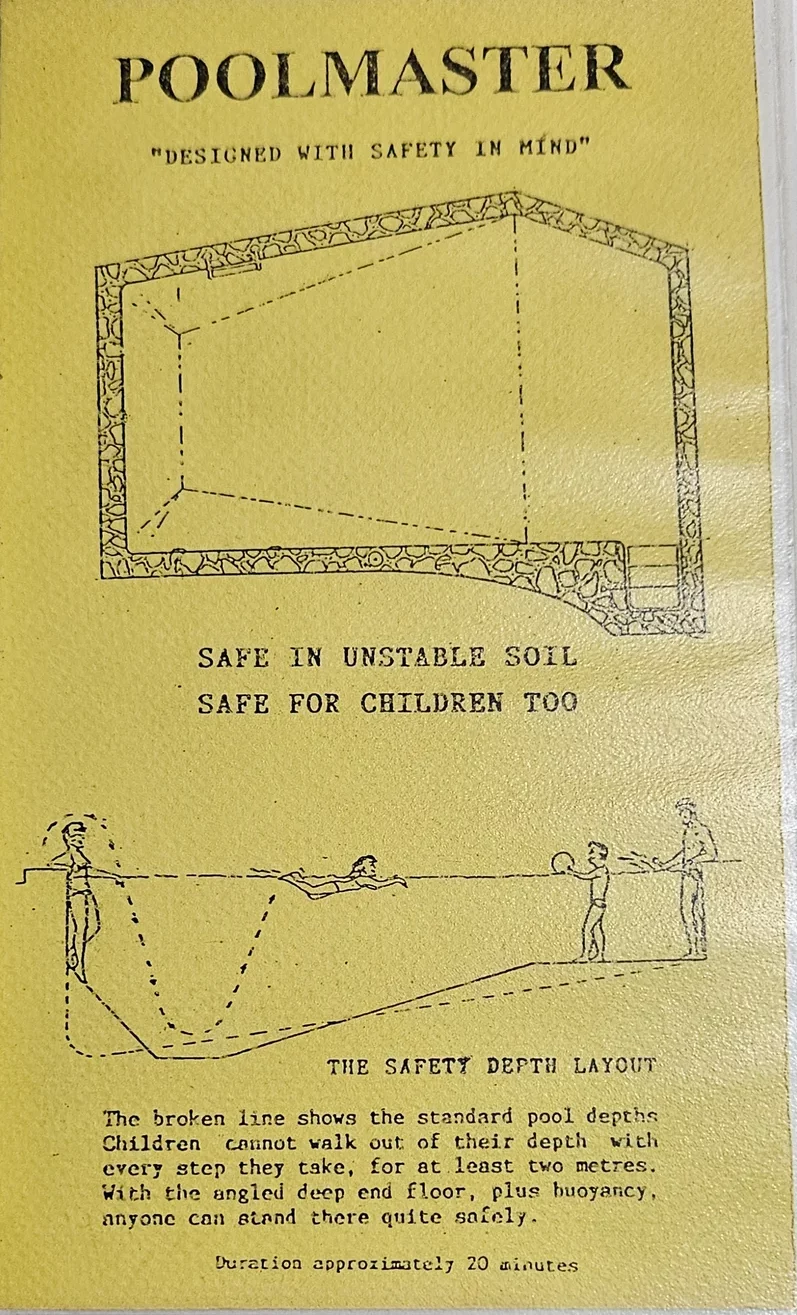
Engineered specifically for South Australia's reactive soils. A galvanised steel wall structure in modular form, set on a compacted sand base with a heavy duty vinyl liner and a stress-free cantilever coping.
Designed to absorb soil movement rather than crack against it.
A 14m (45 ft 3 in) by 16 ft Poolmaster pool installed in December 1972, supervised by Jack Swinburn and built with voluntary labour from parents and committee members.
"Structurally, and mechanically, the installation has been faultless," wrote Headmaster Brian M. Gerlach the following June.
On 11 March 1974, Premier Don Dunstan presented the Industrial Design Council of Australia's Good Design Label to Jack Swinburn at a poolside ceremony in Glenunga. It was Australia's first Good Design Label awarded to a swimming pool.
"This pool is an obvious such example. It looks good. It also works well and is easy to maintain. It's designed with an eye to safety and ease of installation," the Premier said.
Within a week of the Good Design announcement, Australian Letters Patent No. 436726 were sealed on the overall concept, backdated to 1969. To this day, no other Australian pool system has been granted Letters Patent.
Overseas enquiries followed from Singapore, Hong Kong, Indonesia, Bahrain, and Abu Dhabi.
Evidence that a well-engineered hybrid pool, properly built, can last generations.
The methodology has evolved but the principles certainly haven't.
The original 1968 specification documented in detail what made the system work. Many of these principles still apply to hybrid pool construction today.
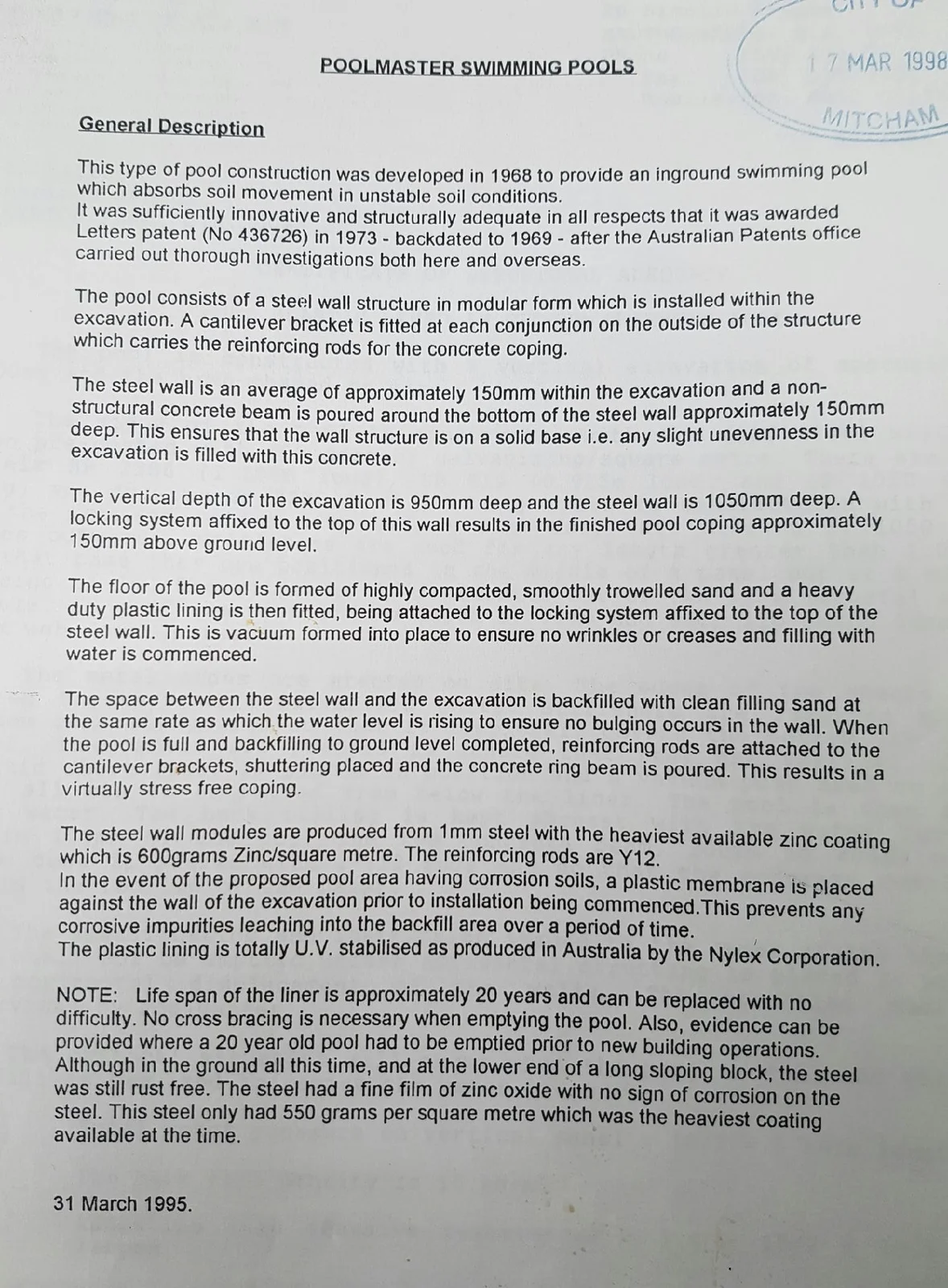
The reactive soils that drove the original 1968 design haven't gone anywhere. Adelaide is still built on country that moves with the seasons, and a pool built for it still needs to flex rather than fight back.
What has changed is everything around the core principle. Modern Aqualux liner finishes outlast the original Nylex Aqualon by decades. Pentair IntelliCenter automation runs filtration and lighting from a phone. Naked Low TDS and Mineral Fresh systems mean dramatically lower chlorine. Variable-speed pumps cut energy costs to a fraction of what 1970s pools required.
But the structure underneath all of that traces back to the same engineering decisions made over fifty years ago!
"We are always available for advice both before and after you have purchased your pool and, after nearly a quarter of a century in the business we think we are well qualified."
Poolmaster Reference Manual, 1990s